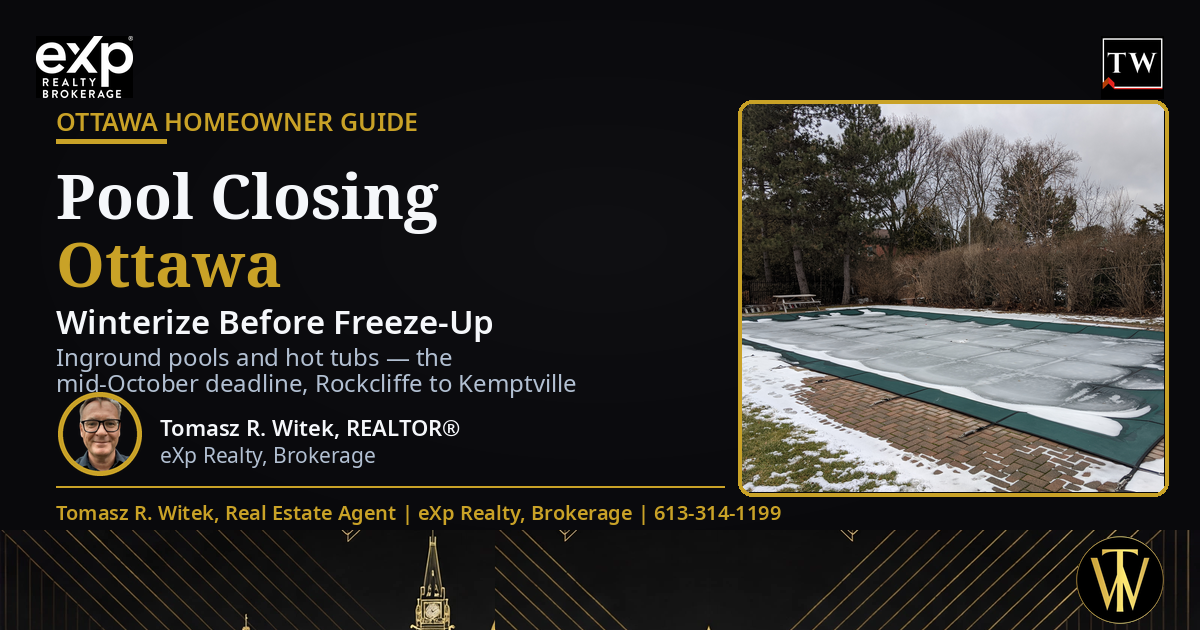
Banner photo: a winterized inground pool under its green mesh safety cover, ice forming on top. Photo by Sikander Iqbal (Wikimedia Commons), CC BY-SA 4.0.
If your pool is still open, you are inside the last safe window of the year — not past it, but close. HB Pools, the Ottawa company that publishes its booking window, takes closings from September 10 to October 20, and adds a $100 fee for closings left until after the first week of November. Puddle Pools, also Ottawa, gives the rule behind the dates: close once the water stays consistently below 15°C, which in Ottawa typically happens between late September and mid-October. Ottawa’s average first frost is October 12. A closing done while the water is still warm wastes chemicals and grows algae under the cover; a closing left until the lines freeze cannot be done at all. Close late — but before freeze-up.
Key facts
When to close: once the water stays below 15°C — Ottawa’s booking window runs mid-September to October 20, and Ottawa’s average first frost is October 12.
What it costs: published closings span $180 to $599.99 +HST.
Who does it: jump to the directory of Ottawa pool closing companies — 20 services, plus the stores where you buy the chemicals to do it yourself.
In this guide
Nobody publishes a count of pools by neighbourhood — the City doesn’t release one — but pools follow lot size and house size, and in Ottawa that means the estate-lot and acreage communities: Rockcliffe Park and Rothwell Heights in the east end; Manotick and Rideau Forest on the Rideau; Greely; Stonebridge and Hearts Desire in Barrhaven; Cedarhill Estates in Nepean; the river lots of Constance Bay and Dunrobin; Carp; the Kanata acreages; and south to Osgoode, North Gower and Kemptville. The pool companies’ own service pages tell the same story — firms build dedicated closing pages for Rockcliffe, Kanata and Orléans because that is where the pools are. Walk the river in Manotick past Watson’s Mill, or drive the big lots of Greely and Carp, and you will see a covered pool behind every third fence.
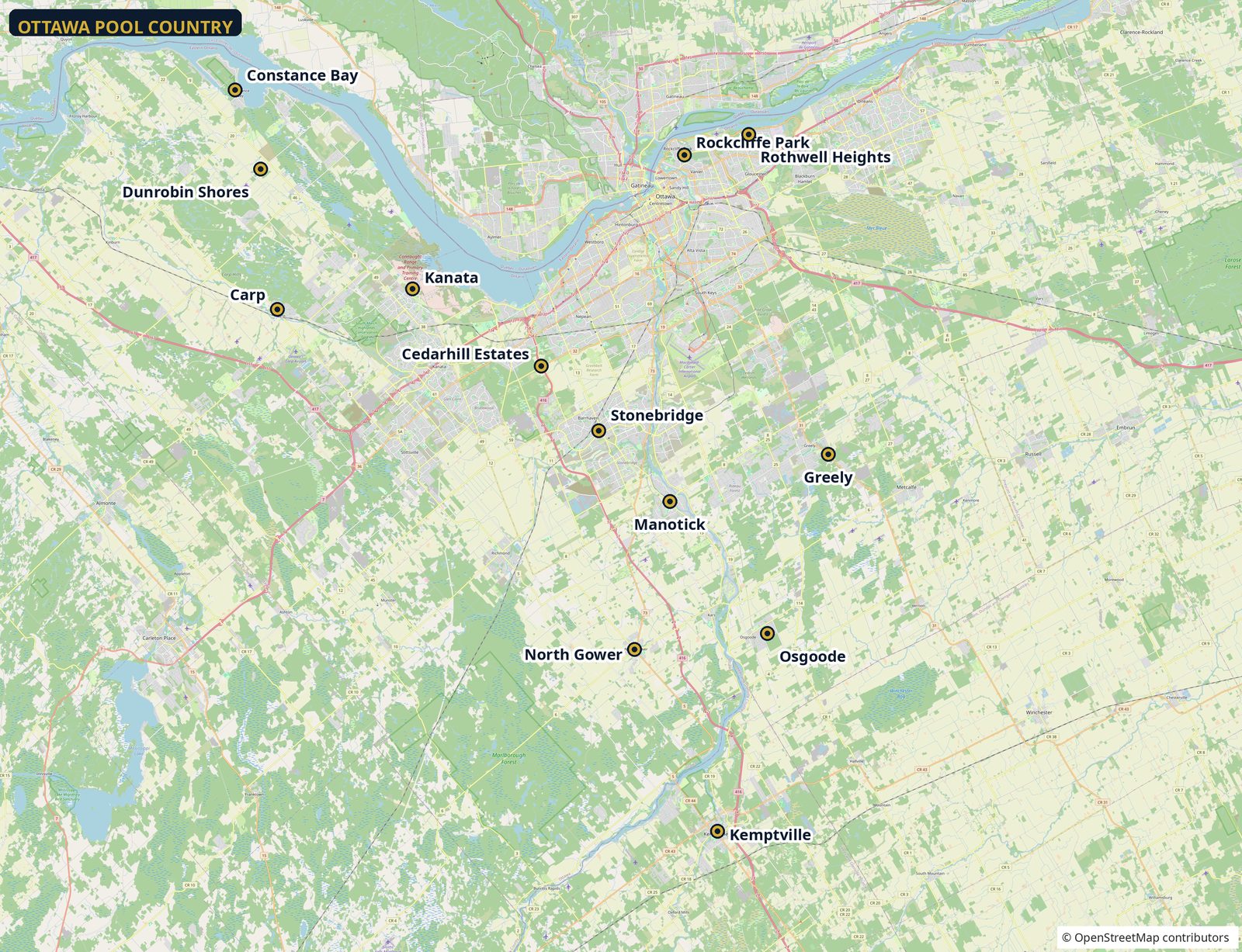
Thirteen pool-country communities around Ottawa — every one of them on the same mid-October clock. Map © OpenStreetMap contributors.
People have been building pools for a very long time. The earliest known large man-made bathing pool is the Great Bath at Mohenjo-daro, in present-day Pakistan, dated to roughly 2600 BCE — the date varies by source, so treat it as approximate; scholars believe it served ritual purification rather than swimming. In Rome, Gaius Maecenas is credited with the first heated pool in the 1st century BCE. The modern public-pool era starts with legislation: Britain’s Public Baths and Wash-houses Act of 1846 let towns fund public baths and pools from public money, in the middle of a cholera-driven public-health movement. Olympic swimming began in open water in 1896 — the first purpose-built Olympic pool came in London in 1908, a 100-metre pool built inside White City Stadium, unheated and unchlorinated. The backyard pool is a post-war invention: rising prosperity and falling construction costs produced the 1950s–60s North American boom, and in Canada the pool landed in middle-class suburban backyards after the Second World War. No source gives a specific date for pools arriving in Ottawa suburbs — anyone who tells you one is guessing — but by the time Barrhaven, Kanata and the estate villages filled in, the inground pool was a standard feature of the big Ottawa lot. And every one of them, every fall, has to be closed.
Inground pools (vinyl liner, fibreglass, concrete/gunite) share one closing sequence; what changes is how far the water is lowered and what the shell cannot tolerate. Vinyl: traditionally about 6 inches below the skimmer mouth — and never drained empty, because the water holds the liner in place and stops it shrinking and shifting. Concrete: about 12 inches below the skimmer mouth, or just below the returns — the tile line is freeze-vulnerable. Fibreglass: follow the manufacturer’s level; Ottawa’s HB Pools runs a duck-plug system on fibreglass that doesn’t lower the water at all. On every shell, a fully drained pool can be lifted by groundwater pressure — the hydrostatic “pop” is the most expensive mistake in this guide.
Above-ground pools close lighter: there are usually no buried lines to blow out — Hayward Canada makes exactly this point. The kit is an air pillow centred under the cover, inflated only about half full so the sheet of ice squeezes the pillow instead of pushing on the walls; a skimmer plate or plug so the water doesn’t have to drop as far; and a cover held by a cable-and-winch around the top rail — never water bags on the rails. Pump, filter and hoses are drained and usually stored indoors.
Indoor pools are not closed. No draining, no line blowing, no cover — the building keeps everything above freezing and the pool stays swimmable all winter. What changes is the building, not the pool: humidity control becomes the whole game (the UK pool standards body SPATA puts pool-hall humidity at a maximum of 55–65%, to stop condensation rotting the structure), heating costs rise because cold outside air has to be warmed, and the pool hall is kept at negative pressure so chlorinated air doesn’t migrate into the house. An indoor pool taken out of service for months is an HVAC mothballing job, not a pool-closing service — and it isn’t something pool companies sell as one.
For a hot tub, winter is not the off-season — it’s the best season, and the manufacturers’ default advice is to keep the tub filled, heated and circulating if you’ll use it at all. Heated, circulating water doesn’t freeze. Royal Spa’s guidance is to drain only if you’ll be away three months or more. The risks of running are real but specific: a multi-day power outage nobody notices, or a water level that drops and lets the pump run dry.
A proper dry winterization — the route if the tub will sit unused — follows Canadian manufacturer Hydropool’s manual: power off, drain completely, remove and clean the filter, vacuum every jet and the filter housing dry with a wet/dry vac, add potable RV antifreeze (propylene glycol — never automotive antifreeze) to the pump wet end, jet lines and filter housing, disconnect the unions, pull the lowest pump drain plug, cover the tub and keep snow cleared off it. The risks run the other way too: miss one pocket of water in a jet line and it cracks; seals and gaskets left dry all winter can dry out, crack and leak at refill. And freeze damage in a winterized tub is not covered by the manufacturer’s warranty — which is why most Ottawa owners who soak all winter simply keep the water hot.
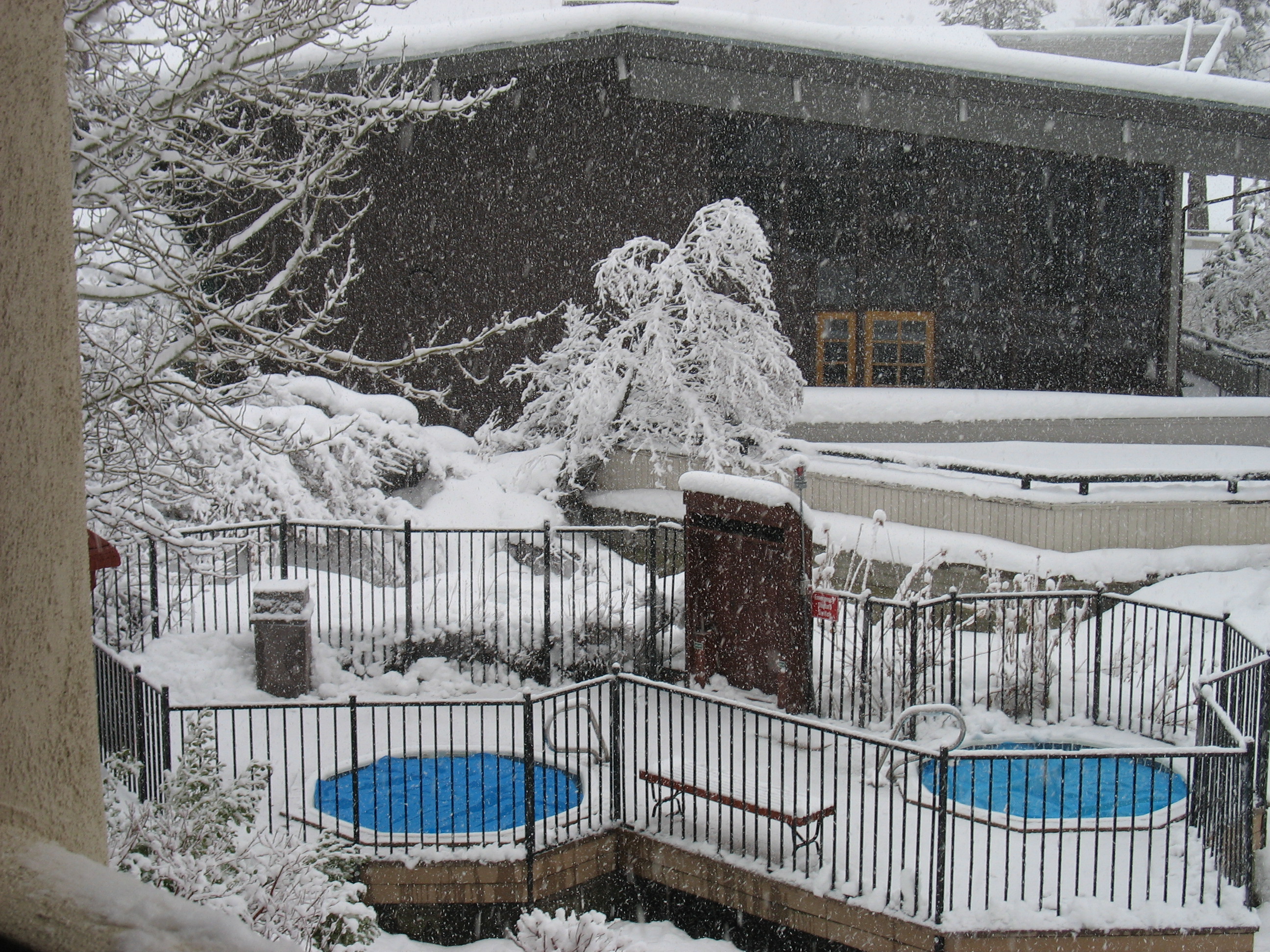
Photo: outdoor hot tubs in falling snow, kept filled and running through winter (Olympic Village Inn). Photo by Rennett Stowe (Wikimedia Commons), CC BY 2.0.
A closed pool is a sealed system for six months — whatever state the water is in on closing day is the state it works on your liner, plaster and equipment with, all winter, with no pump running to forgive mistakes. So the chemistry pass happens a few days before closing day, not the morning of. Test first, and test properly: a liquid drop test kit is the accurate home method, test strips are a quick cross-check, and the most complete read is a sample bottle taken to a pool store’s water lab — most Ottawa pool stores run computerized water testing in-store (the retail list at the end of this guide says which ones advertise it). Test a few days ahead so there is time to adjust, retest, and still close on schedule.
Adjust in this order: alkalinity, then pH, then calcium. Total alkalinity first — 80–120 ppm — because alkalinity is the anchor: it buffers the water so pH can’t drift wildly over the winter. Then pH, 7.2–7.8: run low and the water turns corrosive and etches plaster, grout and metal fittings for six straight months; run high and it lays down scale and goes cloudy. Then calcium hardness, 180–220 ppm on Hayward Canada’s closing guidance: soft water satisfies itself by pulling calcium out of plaster, concrete and grout, while very hard water deposits scale on surfaces and heaters. Vinyl liners don’t give up calcium the way plaster does, but high calcium still scales any surface — and fibreglass owners should follow their shell maker’s range.
Sanitizer and stabilizer. Two or three days before closing, shock the pool — calcium hypochlorite is the standard chlorine shock; non-chlorine oxidizer shock is the other type, and it’s what some winterizing kits use. Then let the chlorine level fall back to the 1–3 ppm range before any algaecide goes in — shock and algaecide are never added together, because high chlorine destroys the algaecide before it can work (Hayward Canada’s sequence, and the reason step order matters). Stabilizer (cyanuric acid, CYA) is the sunscreen that keeps sun from burning chlorine off in summer; Taylor Technologies’ guidance puts the right level for an outdoor chlorine pool at 30–50 ppm. Closing is not the time to add it — too much CYA ties chlorine up and makes it sluggish, and CYA doesn’t break down over winter, it just sits there. If yours ran high all summer, it will still be high in May; the fix is partial water replacement, not more chemicals. Salt-water pools run higher CYA in season (roughly 60–80 ppm) to suit the generator — same rule applies: test it, don’t add to it in October.
The winter-specific chemicals. On top of balanced water, a proper closing adds four specialists. A winterizing algaecide — the long-lasting poly-60 (polyquat) type is the one pros reach for — goes in last among the water chemicals, at the label rate, after the chlorine has fallen, and gets circulated so it reaches every corner; it is the insurance policy that keeps the water from going green under the cover by March. A stain and scale preventer (a metal sequestrant) locks onto iron and copper in the water so they can’t plate out as stains on the liner or steps over winter — it matters most if your fill water is a rural well, where iron is common. An enzyme treatment (closing formulas are sold for exactly this) keeps breaking down the oils, sunscreen and organic residue in the water all winter, which is what stops the black waterline ring you’d otherwise scrub off in May. And some kits add a slow-release winter floater or cartridge that dispenses a trickle of winter chemical until freeze-up — optional, label-directed, and only ever a product made for winter use. The fifth chemical isn’t for the pool water at all: pool antifreeze goes in the plumbing lines (step 7 below).
Salt pools: the salt cell gets cleaned — descaled — before it comes off the line and is stored indoors for the winter, and the generator is shut down for the season. Two Ottawa firms publish the job as a priced line item (GBI at $35, Purewater at $49.99, directory below), which tells you it’s a step, not an upsell.
The closing-chemicals shopping list (for the DIY version): a winterizing kit sized to your pool — kits bundle the shock, winter algaecide and stain & scale preventer, and are usually the economical route; two Ottawa-published prices anchor the range: Purewater sells its closing chemical kit at $49.99, and GBI’s closing chemical kit is a $56 add-on on a booked closing — or the same three products bought separately. Plus: a test kit or fresh strips; non-toxic pool antifreeze, roughly a bottle per line (HB Pools publishes $14.95 +HST a bottle); an air pillow for an above-ground pool; and water bags or cover clips if you run a tarp cover. Everything on that list is stock at the stores in Part B of the directory below.
Skip the balance and the winter sends the bill: algae blooms quietly under the cover and you open to a green swamp in May; scale builds a rough line at the waterline; dissolved metals stain liners and steps; soft, acidic water etches plaster; and excess chlorine left in at closing fades a liner by spring. Every one of those is a spring expense that a $50 kit and an hour of testing in October prevents.
This is the sequence the industry teaches — Hayward Canada’s order — and it’s what a professional crew is working through at your house:
Ottawa rules for the water you pump out. No pool water of any kind can be discharged onto the street — it must be contained on your own property. That includes dechlorinated water: Ottawa used to allow dechlorinated water onto the street, but the city changed the rule, and saltwater pool water likewise stays on your property, never into the storm system. When the crew lowers your pool, that rule is why the hose runs where it runs. (With thanks to Poolarama, one of the closing companies in this guide, for flagging the bylaw change.)
Water expands about 9 percent when it freezes, and in a closed pipe that expansion has nowhere to go — it is the pressure, not the ice itself, that splits the fitting. Ottawa’s January mean daily minimum is −14.3°C (1991–2020 climate normals), and the typical coldest night of the year runs far below that. The parts that burst first are not the straight pipe runs — they’re the rigid housings holding trapped water: skimmer bodies, pump housings, filter tanks and heater heat exchangers. There is no published Ottawa price list for freeze repairs; for scale only, US national guides put filter replacement at US$200–$1,500, heater repair at US$165–$765 and a pump motor at US$700–$1,500. The local arithmetic is simpler: one cracked heater exchanger costs more than a professional closing — published prices span $180 to $599.99 +HST.
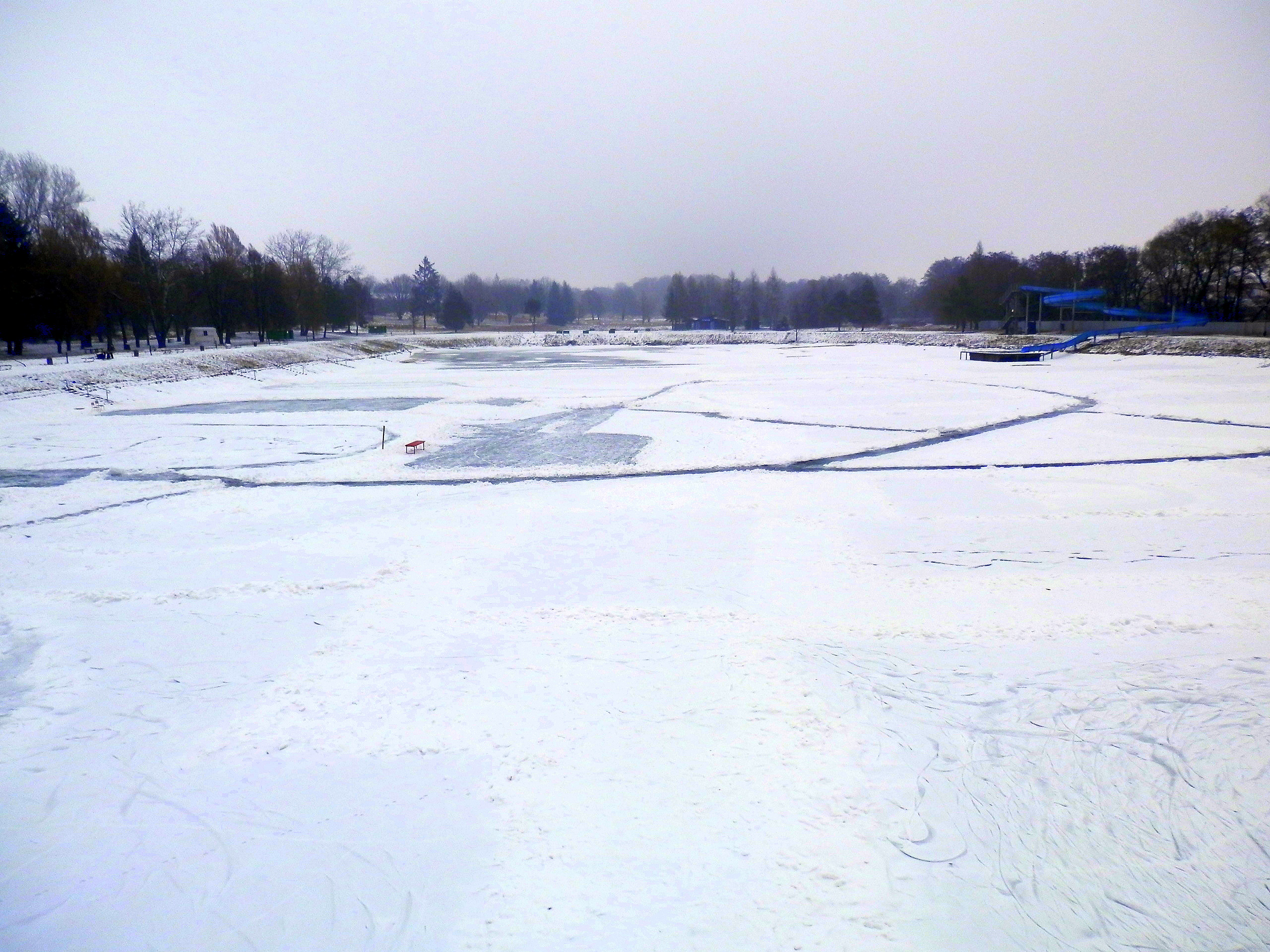
Photo: an outdoor swimming pool frozen over in mid-winter (Delňa pool, Prešov). Photo by Ing.Mgr.Jozef Kotulič (Wikimedia Commons), CC BY-SA 4.0.
A proper line blow-out is about air volume, not pressure: the industry tool is a high-volume blower (Cyclone-type, roughly 5 psi at about 130 CFM). A shop compressor is the opposite — high pressure, low flow — and can damage plumbing; a shop vac can clear returns on a simple pool but often can’t bubble a deep main drain. What the pros do that DIYers miss: air-locking the main drain; antifreeze after the blow-out, dosed per line; removing the salt cell and the pressure gauge; storing the plugs in the pump basket; and winterizing the forgotten extras — the second skimmer, the waterfall, the solar loop, the attached spa. GBI’s add-on menu, below, reads like a catalogue of the lines homeowners forget.
Published closings in Ottawa span $180 to $599.99 +HST. The low end is TN Pools’ starting price — from $180, pool type not specified — from an Alexandria-based company serving Ottawa. The companies with full published price lists cluster around $320–$440 for a standard closing: GBI publishes $319.99 +HST and HB Pools $330 +HST. The top of the span is GBI’s $599.99 +HST full cover package. For orientation, HB Pools’ own cost guide estimates the Ottawa market at $300–$600 — that figure is a company-blog estimate, not a quote. Purewater and 4 Season publish full itemized menus, in the table below. Everyone else quotes per pool. Closing it yourself instead? Part B of the directory, right after the services, lists the stores where you buy the closing chemicals and get your water tested.

| Company | Area | Published price | Phone |
|---|---|---|---|
| GBI Pool Services | Carp | $319.99 +HST no cover · $424.99 +HST no cover + drain · $599.99 +HST with one cover installed. Published add-ons: closing chemical kit +$56, winterize attached spa +$135, winterize solar heater +$135, salt cell cleaning $35. | 613-797-7665 |
| HB Pools | Ottawa | $330 +HST equipment closing or duck-plug system · $440 +HST duck-plug + safety cover install. Antifreeze $14.95 +HST per bottle; +$100 late fee after the first week of November. | 613-212-0036 |
| Purewater Total Home Leisure | Nepean (2070 Robertson Rd) | Published closing menu (their booking page; last updated June 2023 — confirm when you book): basic closing $259.99 (residential, one skimmer, up to 135,000 L) · lower water level $79.99 non-salt / $99.99 salt · safety cover install $79.99 · tarp cover install $109.99 ($149.99 with leaf net) · close spill-over spa $199.99 · salt cell cleaning $49.99 · winterize extra skimmer $59.99 · closing chemical kit $49.99 — HST extra. A typical configured closing (basic + water lowering + tarp cover) comes to about $450 before HST. | 613-726-0099 |
| Brady’s Pool & Spa Care | Bells Corners, Nepean | Pool opening & closing service; no published price. | 613-820-7556 |
| Mermaid Pools | Nepean + Orléans | Pool closing in its seasonal packages; no published price. | 613-714-7946 |
| Puddle Pools | Alta Vista, Ottawa | Dedicated Ottawa closing service; no published price (free quote). | 343-473-0131 |
| Ottawa Pool Services | Kanata | Pool closings listed in its maintenance services; no published price. | 613-447-7299 |
| Campbell Pools | Orléans (1344 Youville Dr) | Booking 2026 closings; no published price. | 613-834-6243 |
| Campbell Pools | Embrun (115 Bay St) | Booking 2026 closings; no published price. | 613-443-1526 |
| TN Pools | Alexandria, serving Ottawa | Pool closings from $180 (pool type not specified). | 613-551-5631 |
| ML Pool Services | Kinburn, west Ottawa | Openings and closings; no published price. | (613) 832-3893 |
| Ottawa Valley Pools | Ottawa south | Opening and closing services; no published price. | (613) 415-7444 |
| Benson Pools | North Gower | Pool closing service; no published price. Note: Benson does not service above-ground pools. | 613-263-5040 |
| 4 Season Pool & Spa Care | Stittsville | Published winter closing packages (tax extra): Gold $495 inground / $400 above-ground · Silver $325 · Bronze Plus $425 inground / $300 above-ground · Bronze $225. | 613-831-8974 |
| Poolarama | 881 Richmond Rd, Ottawa | Pool openings, closings, dechlorination and water analysis; no published price. | (613) 728-1731 |
| Splash Pools and Spas | Manotick (1143 Tighe St) | Pool openings & closings among its services; no published price. | 613-692-1804 |
| Pool Builders Ltd | Stittsville (1127 Carp Rd) | Pool openings and closings; no published price. | 613-836-1324 |
| St. Lawrence Pools | Kemptville (2970 County Rd 43 — a seasonal store) | Pool closing service; no published price. | (613) 784-9024 (store) · (613) 499-5510 (service) |
| Aqua Clear Pool & Spa Service | Stittsville | Pool opening & closing; no published price. | 613-831-2747 |
| JMD Pools | Gloucester | Pool closing and winterizing; no published price. | 613-880-1111 |
| MCI Pools | Ottawa | Pool opening & closing; no published price. | 613-424-8112 |
The stores below are retailers, not closing services — they are here because a DIY closing runs on their shelves: the winterizing kit, shock, algaecide, stain & scale preventer, test kits, antifreeze, air pillows and cover clips from the shopping list above, and a water lab that will test your sample and tell you exactly what to add.
| Company | Area | What they stock | Phone |
|---|---|---|---|
| Sani-Sol Pool & Spa | Stittsville (149 Iber Rd) | Pool and spa supply store carrying the BioGuard lines, with in-store water testing (their homepage: “Come get your water tested”). | (613) 831-3698 |
| Club Piscine Super Fitness | Nepean (285 West Hunt Club Rd) | Pool and spa supply store — closing chemicals, covers and water-test supplies in store and through the chain’s online shop. The chain’s site lists the store but publishes no store e-mail or phone, so none is printed here. | — |
One note on prices: the figures in this directory are the prices the companies had published when this guide was written, and prices may have changed since. Please call the service provider to confirm current, up-to-date pricing before you book.
Closing the pool usually happens the same week as the other big October water job — blowing out the sprinkler system before the first hard freeze. Do both in October and the house is put to bed.
I’m Tomasz R. Witek, a real estate agent with eXp Realty, Brokerage, and I’ve been selling homes across Ottawa since 2005 — from Rockcliffe Park and Manotick to Greely, Carp and Kemptville. Every fall I give my clients the same advice: the cheapest week to own a pool is the week you close it properly. If you’re thinking of buying or selling in any of these communities, I’d be glad to help.
When should I close my pool in Ottawa?
Once the water stays consistently below 15°C — typically late September to mid-October here. The published Ottawa booking window runs September 10 to October 20; Ottawa’s average first frost is October 12, and at least one Ottawa firm adds a $100 fee after the first week of November. Closing too early, in warm water, wastes chemicals and grows algae under the cover.
How much does a pool closing cost in Ottawa?
Published prices span $180 to $599.99 +HST: TN Pools starts from $180 (pool type not specified); GBI’s packages run $319.99 to $599.99 +HST; HB Pools is $330 +HST, or $440 with a safety cover; Purewater’s itemized menu builds a typical closing to about $450 before HST; 4 Season’s packages run $225 to $495. One Ottawa firm’s cost guide estimates the market at $300–$600 — treat that as an estimate, not a quote.
Can I close my pool myself?
Yes — if you can move enough air. Lines are cleared with a high-volume, low-pressure blower, not a high-pressure compressor, which can damage plumbing. The steps DIYers most often miss are air-locking the main drain, adding antifreeze after the blow-out, and removing the salt cell and pressure gauge for indoor storage.
Should I drain my hot tub for the winter?
Usually not. If you’ll use it, keep it filled, heated and circulating — that’s the manufacturers’ default advice, and winter is prime soaking season. Drain and winterize it dry only if it will sit unused for months, and follow the manufacturer’s sequence exactly: a tub winterized badly is itself a freeze risk, and freeze damage in a winterized tub is not covered by the manufacturer’s warranty.
Mesh or solid — which winter cover is better?
A solid tarp blocks all light, so it suppresses algae best, but meltwater pools on it and needs a cover pump, and it’s held down with water bags. A mesh safety cover is anchored to the deck, lets water drain through (no pump), and usually lasts longer — but lets in fine silt and some light. Either beats no cover; the anchored safety cover is where most Ottawa pros have landed.
Thinking about buying or selling in Rockcliffe Park, Rothwell Heights, Manotick, Greely, Stonebridge, Carp, Kanata — or anywhere in Ottawa’s pool country? I am Tomasz R. Witek, a REALTOR® and Real Estate Agent with eXp Realty, Brokerage — Exp613, and the Polski agent w Ottawie. I have been selling homes in Ottawa since 2005, and these are communities I know street by street. For a free, no-pressure conversation about your home — its price, its timing, its story — call or text me at 613-314-1199.
Tomasz R. Witek, Real Estate Agent | eXp Realty, Brokerage | 613-314-1199 | Exp613 | Polski agent w Ottawie